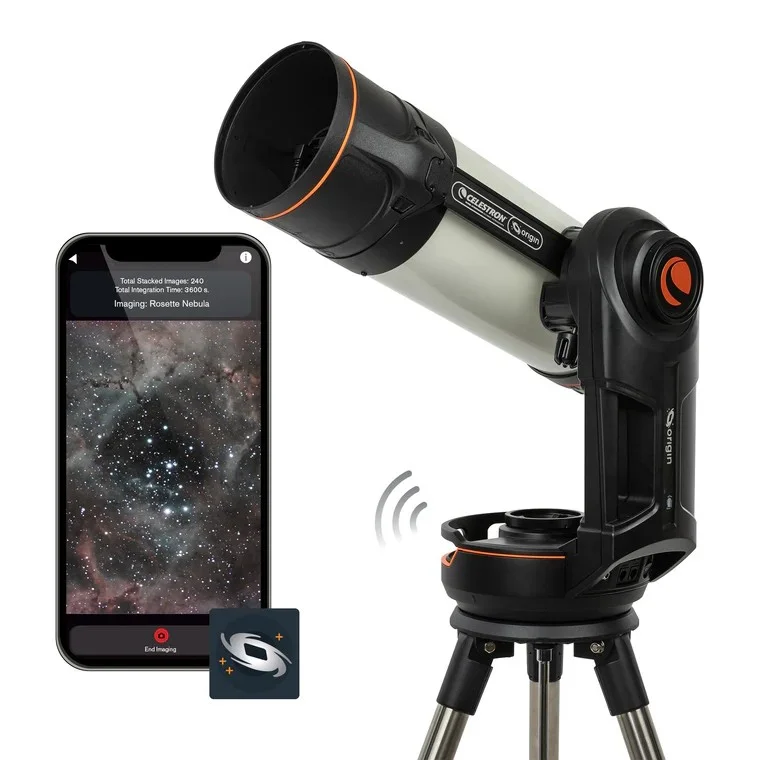
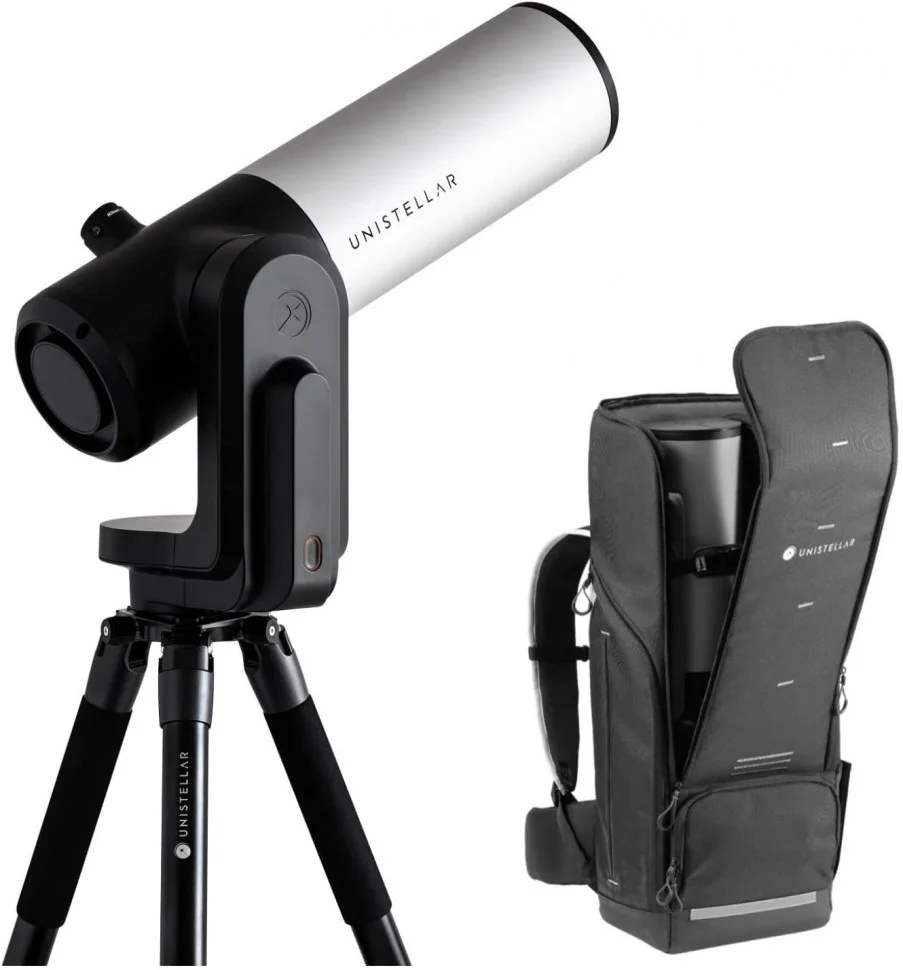
↓The models are presented at the bottom of the article↓
When choosing the best and most professional telescope, a novice astronomy enthusiast pays attention to its cost as a guarantee of a “high‑quality, crisp image.”
Yes, the cost undoubtedly plays a role — creating an excellent instrument requires more time and resources to manufacture, and here I suggest taking a moment to understand its design and how the practice of observation actually works.
A telescope, in a simplified understanding, is a design consisting of two magnifying lenses, where the first magnifying lens (the tube with its optical system) brings the cosmos closer, and the second (the eyepiece magnifying lens) brings what the first one brought closer.
Unfortunately, almost all telescope manufacturers equip their products with mediocre eyepieces. As a result, even the most expensive telescopes “out of the box” produce images with limited capabilities.
To put it in perspective, imagine you’re being offered a high‑tech TV without a remote control, or a home theater sound system with full surround sound and only two speakers.
The speakers make noise, the TV is on, but the potential and capabilities are not being utilized. The same goes for astronomical equipment.
Yes, depending on the diameter of the lens/mirror and the focal length, the telescopes on offer may have different light‑gathering power and initial field of view, but without the appropriate eyepieces, this loses its meaning.
A general understanding of the design of a telescope’s optical system (objective lens) and the influence of its individual components on the result will help us choose the best instrument with all the necessary lenses to suit your needs. Here, as in chess, you need to develop the strengths of the objective lens (optical system) under consideration, while taking its weaknesses into account. Some objectives are good at revealing deep‑sky objects, while others are better for observing planets. Everything can be clearly seen with small apertures and optical systems that are complex to manufacture.
The selection of the required eyepiece can be carried out using the scheme of sequential connection of the efficiency of the entire system, where the parameters of the elements, when multiplied together, influence the overall result due to their state/quality. The simplified formula looks something like this:
η= η₁ × η₂ × η₃ × η₄ × η₅ × η₆
where
η – overall efficiency or the result of observations (shooting)
η₁ – the object of observation
η₂ – atmosphere ± urban glare
η₃ – “fast” or “slow” telescope
η₄ – eyepiece ± mirror or prism
η₅ – observer’s eye (camera)
η₆ – experience of observations (shooting)
Light is reflected/propagates from an object in space in all directions, passes through Earth’s atmosphere, reaches our two magnifying lenses, and is registered by us at the telescope’s focal point. Each eyepiece provides different magnification and field of view, so it’s important to have 3 to 5 of them for all situations. Sometimes the atmosphere is unstable and not transparent enough; in this case, you need to choose a lower magnification to achieve a clear image.
Since the process is quite sequential, the presence of weak links must be eliminated, as the result of multiplying all the coefficients will be close to the value of the weakest link.
Let’s say you decided to observe Mars (η₁), visited the Curiosity rover’s website, and read the daily weather report. There are no dust storms; you might be able to observe the polar caps. You checked the weather and the presence of low/medium/high clouds at the предполагаемой observation point (η₂). We opened the electronic planetarium on our mobile phone, took a time journey in augmented reality using the coordinates of the предполагаемой point, and learned that the planet would appear above the horizon in the evening at such‑and‑such time (η₆). In advance (η₆), we set up our 20‑cm long‑focus telescope with auto‑guiding (η₃) and a set of high‑quality eyepieces (η₄) at an open observation site (η₆). They adapted their eyes to the darkness (η₅) to see better and began to point the telescope at the object, switching between eyepieces from lower magnification to higher (η₆). Depending on the state of our atmosphere (η₂) at the time of observation, we choose the optimal clarity between the last two eyepieces, and that’s it — we’re enjoying it.
We can check the distance from Mars to Earth and divide it by the speed of light in seconds; the image from the past reaches us in 3 to 20 light minutes at the time of minimum and maximum distance. The magnification realized by the telescope together with the eyepiece, the so-called multiplicity, is a reduction in the distance between you and Mars by this number of times. Imagine this distance divided by 300 times.
Overcoming such distances, especially in comparison with the circumference of our Earth, you may unwittingly begin to lose your sense of time. At this moment, the sounds of human presence will disappear, the noise of car engines on the road will disappear, the forest will stop and the field will freeze. Here, your telescope, like a creaking iron door, gently opens a new dimension, where you become part of the grandeur surrounding you, blurring the line between the obvious and the imagined.
The lists below have proven themselves highly in all circles of astronomy enthusiasts in Russia and abroad. Contact us, and our experts will help you sort everything out and find the best solution — not just offer a solution, but show you, teach you, and set it up.